
Treatment Center Lead Follow-Up: How to Nurture Admissions Inquiries Without Losing the Human Touch
Treatment center lead follow-up is not about sending more messages. It is about making sure someone who reaches out for help does not disappear simply because they were not ready to move forward during the first conversation.
An admissions inquiry may need time. A person may be comparing programs, discussing treatment with family, figuring out logistics, waiting on information, or simply not be ready to make a decision that day.
The right follow-up process keeps the door open without turning a sensitive conversation into an aggressive sales sequence.
For treatment centers, that means combining timely outreach, clear human handoffs, appropriate automation, and careful attention to privacy and sensitivity.
Key Takeaways
Treatment center lead follow-up should support the admissions journey, not pressure people into a decision.
A single unanswered call or unreturned message should not automatically end the relationship.
AI lead follow-up can handle repetitive administrative outreach while keeping staff involved when conversations require human judgment.
Long-term lead nurture should be relevant, respectful, and based on the inquiry’s context.
Treatment centers should define clear boundaries around what AI can say, what information it can collect, and when a human must take over.
Success should be measured by responsiveness, meaningful engagement, appropriate next steps, and admissions outcomes, not message volume.
Why Treatment Center Lead Follow-Up Is Different
A treatment inquiry can carry more weight than an ordinary commercial lead.
Someone may be reaching out because they need help themselves. A family member may be looking for options for someone they care about. Another caller may simply be gathering information and may not know what kind of support they need yet.
That makes the follow-up experience part of the overall impression of the treatment center.
A generic sequence of sales messages can feel inappropriate in this context.
Effective treatment center lead follow-up should feel like continued access to help, not pressure to buy.
Why Do Admissions Inquiries Go Cold?
An inquiry can stop responding for many reasons.
The person may:
Need time to make a decision
Be comparing treatment options
Need to speak with family
Be working through insurance or financial questions
Have transportation or scheduling concerns
Become overwhelmed
Have reached out before they were ready
Have had difficulty connecting with admissions
Simply miss a callback
Silence does not always mean the person is no longer interested.
That is why the follow-up process needs more nuance than a simple “called once, no answer” status.
What Is Treatment Center Lead Follow-Up?
Treatment center lead follow-up is the process of maintaining appropriate communication with people who have previously contacted a treatment organization but have not yet progressed to the next admissions step.
That can include:
Returning missed calls
Following up after an initial inquiry
Answering outstanding administrative questions
Confirming a scheduled conversation
Reconnecting with an inactive inquiry
Routing the person back to admissions
Recording the outcome in the appropriate system
The purpose is continuity.
Someone should not have to start from the beginning every time they reconnect with the center.
How Should Treatment Centers Follow Up With New Inquiries?
The first follow-up should be focused on helping the person continue the conversation.
A practical workflow is:
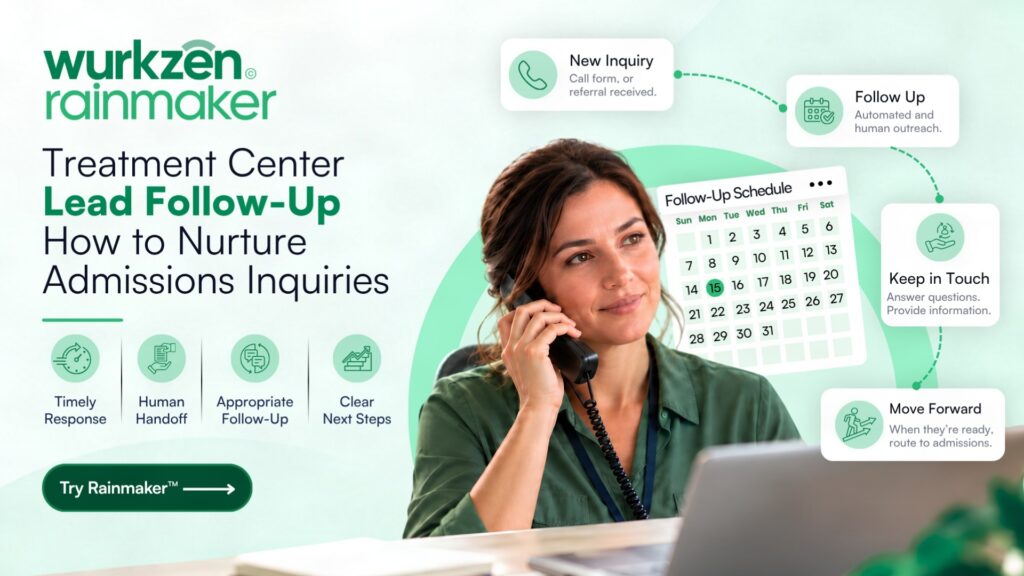
Inquiry → immediate response → understand the need → provide approved information → human handoff → follow-up if needed
The exact process depends on the center, but the principle is consistent.
Do not make the person repeat information unnecessarily. Give them a clear way to reconnect with the appropriate team.
Step 1: Respond While the Inquiry Is Fresh
Speed matters because the person has already taken the step of reaching out.
If an admissions team is unavailable, an automated system can acknowledge the inquiry and create a path to follow-up.
For phone inquiries, that might mean answering the call directly or triggering an appropriate callback workflow.
The objective is not to automate the entire admissions conversation. It is to prevent an inquiry from becoming invisible.
Step 2: Understand the Context
Before starting a follow-up sequence, understand what happened during the original interaction.
Was the person:
Asking about a program?
Requesting a callback?
Trying to reach admissions?
Looking for general information?
Interested but not ready?
Unable to complete the conversation?
Waiting for a specific next step?
The answer should influence what happens next.
Someone waiting for a callback should not receive the same communication as someone who simply requested general information.
Step 3: Give the Person a Clear Next Step
Every follow-up should make it easy to continue.
That might mean offering a callback, connecting with admissions, answering an approved operational question, or scheduling an appropriate conversation.
Avoid creating unnecessary friction.
If someone has already expressed interest in speaking with admissions, they should not have to navigate a complicated process just to reconnect.
Step 4: Keep Human Staff in the Loop
Automation should support admissions staff, not hide them.
When someone is ready to have a substantive conversation, the workflow should make it easy for a trained member of the team to take over.
The staff member should have access to relevant context so the person does not need to repeat the entire story.
This is especially important in treatment settings, where trust and continuity can matter as much as speed.
What Is AI Lead Follow-Up?
AI lead follow-up uses AI to handle defined communication and administrative tasks after an initial inquiry.
In a treatment-center context, that might include:
Attempting an approved callback
Answering predefined operational questions
Confirming a scheduled conversation
Sending an approved reminder
Alerting admissions staff
Recording the outcome of an interaction
Routing a person back to the appropriate team
AI should operate within a clearly defined scope.
It should not improvise clinical guidance or attempt to replace trained professionals in sensitive situations.
How Can Automation Support Long-Term Lead Nurture?
Not every inquiry turns into an admissions conversation immediately.
Some people may need additional time before they are ready to engage.
Long-term lead nurture can keep the communication path open without requiring admissions staff to manually remember every inquiry.
A workflow might look like:
Initial inquiry → follow-up → no response → appropriate later outreach → response → human handoff
The timing and content should depend on the center’s policies and the nature of the communication.
The objective is persistence without pressure.
What Does Persistent Sales Follow-Up Mean in Treatment Settings?
Persistent follow-up does not mean repeatedly calling someone until they answer.
For treatment centers, persistence should mean maintaining an appropriate path back to support.
That distinction matters.
In a traditional sales environment, repeated outreach may be designed to create urgency. In a treatment setting, follow-up should be respectful and sensitive to the circumstances of the person seeking help.
A useful standard is:
Be available without becoming intrusive.
How Many Follow-Ups Should a Treatment Center Make?
There is no universal number that applies to every treatment center or every inquiry.
The appropriate cadence depends on factors such as:
What the person requested
Whether they explicitly asked for a callback
Whether they responded previously
The urgency of the situation
The communication channel
Applicable privacy and communication requirements
The center’s own policies
Rather than choosing a generic number of attempts, define rules around intent and consent where applicable.
If someone asks not to be contacted, the workflow should respect that request and follow the center’s applicable compliance requirements.
How Should AI and Humans Divide Follow-Up Work?
A useful division is straightforward.
Follow-Up Task | AI Role | Human Role |
|---|---|---|
Initial response | Respond or acknowledge | Take over when needed |
General operational questions | Provide approved answers | Handle exceptions |
Callback scheduling | Assist with scheduling | Conduct the conversation |
Basic administrative intake | Collect approved information | Review and continue |
Sensitive questions | Escalate | Respond directly |
Clinical questions | Do not improvise | Qualified professional handles |
Complex admissions conversation | Route | Admissions staff handles |
Follow-up reminders | Support approved workflow | Review when appropriate |
Crisis-related situation | Follow defined escalation protocol | Trained staff handles |
This keeps automation focused on repeatable work while preserving human involvement where it matters most.
What Should an AI Lead Follow-Up System Know?
The system needs enough context to avoid treating every inquiry as new.
Relevant information may include:
Previous contact history
Reason for the original inquiry
Requested follow-up
Appointment status
Assigned admissions team member
Previous communication outcome
Preferred communication method, where appropriately collected
Current status in the admissions workflow
The goal is continuity, not surveillance.
Only information necessary for the defined workflow should be collected and used.
How Should Treatment Centers Handle Sensitive Information?
Treatment-center follow-up can involve highly sensitive information.
That means automation should be designed around the center’s privacy and compliance requirements from the start.
Before deploying AI, the organization should determine:
What information the system needs
What information it is allowed to collect
Where information is stored
Who can access it
How long information is retained
Which systems receive the information
What vendor agreements are required
Which communications are permitted
Healthcare compliance note: HIPAA and other privacy requirements can vary based on the organization, workflow, information involved, and vendor relationship. A qualified privacy or compliance professional should review any workflow that handles protected health information before deployment.
How Should Treatment Centers Handle Crisis or Urgent Situations?
A follow-up system should never assume that every inquiry is an ordinary admissions conversation.
If a person communicates a potential emergency, immediate danger, suicidal thoughts, overdose, severe withdrawal, or another urgent concern, the workflow should follow the treatment center’s established escalation protocol.
AI should not attempt to make an independent clinical assessment.
The center should define exactly when automation stops and trained staff or emergency resources become involved.
This workflow should receive clinical and operational review before deployment.
How Can Treatment Centers Avoid Making Follow-Up Feel Robotic?
The answer is not simply to make AI sound more human.
The workflow itself needs to be human-centered.
That means:
Keep messages concise
Use the context of the previous interaction
Avoid unnecessary questions
Make it easy to reach a person
Do not pressure someone into a decision
Respect communication preferences and applicable opt-outs
Escalate when the conversation requires human judgment
Give staff enough context to continue naturally
A warm tone cannot compensate for a bad workflow.
If someone has already explained why they are calling and the next message asks them to explain everything again, the experience still feels automated.
How Rainmaker Can Support Treatment Center Lead Follow-Up
Rainmaker can support the operational side of treatment center lead follow-up through specialized voice AI agents and connected workflows.
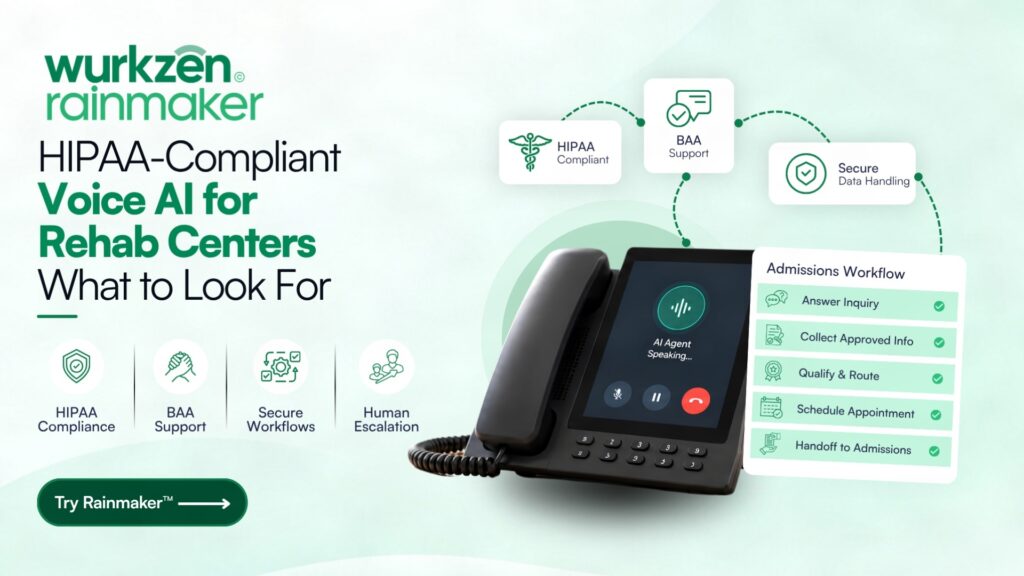
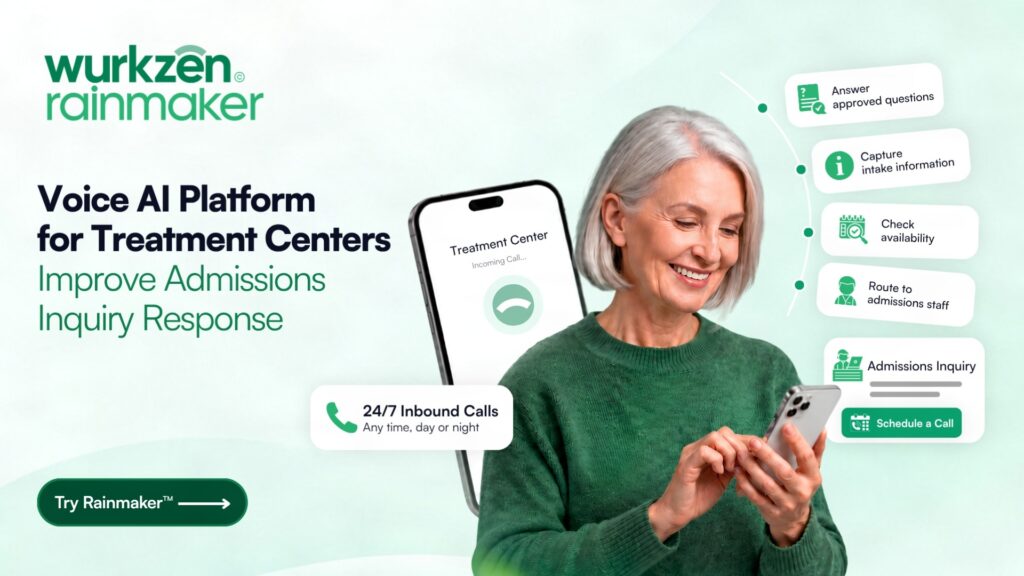
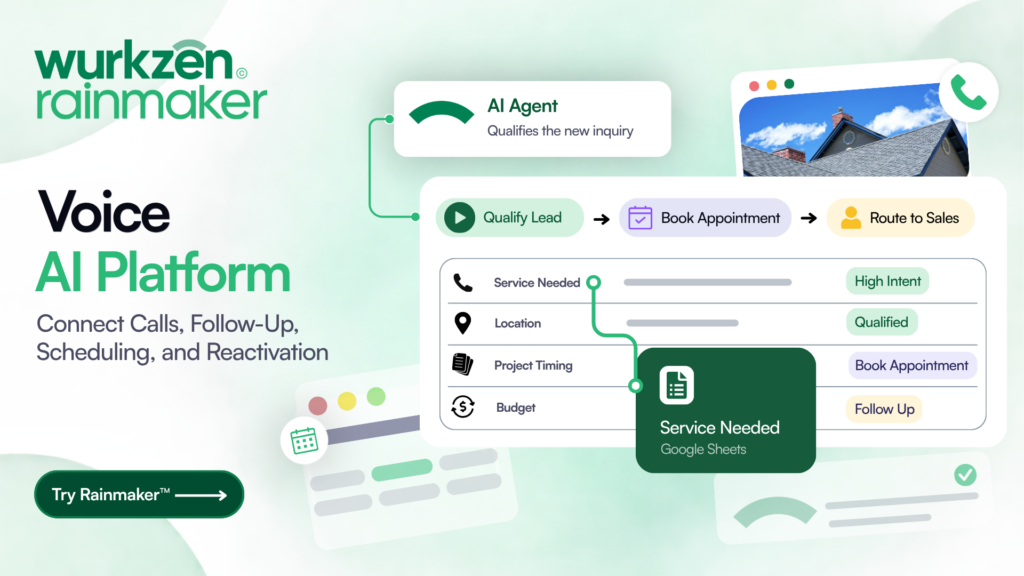
The Qualifier can handle inbound inquiries, collect defined qualification information, and route appropriate conversations to staff.
The Receptionist can provide phone coverage, answer approved questions, and support scheduling.
For inquiries that do not move forward immediately, Rainmaker’s Outreach and Sales Caller can support follow-up workflows, while CRM integrations can help keep activity connected to the appropriate contact record.
A treatment-center workflow could look like:
Inquiry → immediate response → approved information → administrative qualification → human handoff → follow-up → re-engagement when appropriate
Rainmaker can also provide activity history, call recordings and transcriptions where configured and appropriate, and real-time alerts through channels such as SMS, email, Slack, or in-app notifications.
For healthcare organizations, the configuration and compliance review matter as much as the automation itself. Treatment centers should define exactly what the system can say, collect, store, and trigger before putting an AI workflow into production.
How to Build a Treatment Center Lead Follow-Up Workflow
Step 1: Map the current admissions journey
Start with what happens today.
Document the path from first inquiry through admissions, including missed calls, unanswered callbacks, scheduling, and inactive inquiries.
Step 2: Identify where inquiries disappear
Look for points where people stop receiving timely attention.
Common gaps include after-hours calls, missed callbacks, incomplete intake, and inquiries that never receive a second contact attempt.
Step 3: Separate administrative from clinical work
Mark which tasks can be automated and which require trained professionals.
Do not automate clinical judgment simply because a conversation can technically be handled by AI.
Step 4: Define communication rules
Specify what the AI can say, what it cannot say, when it should escalate, and how staff should be notified.
Step 5: Create follow-up paths
Build different workflows for different situations.
For example:
Missed call → callback
Information request → approved response → optional follow-up
Ready for admissions → human handoff
No response → appropriate later outreach
Sensitive or urgent situation → immediate escalation
Step 6: Connect the CRM or admissions system
Record relevant activity where staff already work.
The team should be able to see what happened without searching through separate systems.
Step 7: Review conversations regularly
Use appropriate quality-review processes to identify where the AI is helping, where callers become confused, and where escalation rules need improvement.
For healthcare workflows, involve the appropriate operational, privacy, and clinical reviewers.
What Should Treatment Centers Measure?
The best metrics measure access and progress, not just automation.
Metric | What It Shows |
|---|---|
Inquiry response time | How quickly people receive attention |
Answer rate | How many inbound inquiries receive a response |
After-hours inquiry capture | How many off-hours inquiries enter the workflow |
Contact rate | How often follow-up produces a conversation |
Human handoff rate | How often staff become involved |
Follow-up completion | Whether required next steps happen |
Appointment or assessment scheduling | Progress toward the next appropriate step |
Inquiry-to-admissions rate | Downstream performance |
Abandonment rate | Where people leave the process |
Opt-out or complaint rate | Whether outreach is becoming intrusive |
A high number of automated contacts is not automatically a good result.
A better outcome is an appropriate person receiving a timely response and reaching the right next step.
Common Treatment Center Follow-Up Mistakes
Treating every inquiry as a sales lead
Admissions inquiries require a different standard of communication.
The person may be looking for help during a difficult situation, not shopping for a product.
Sending the same sequence to everyone
An inquiry from yesterday should not necessarily receive the same follow-up as an older contact from several months ago.
Use context to determine the appropriate workflow.
Automating clinical conversations
Administrative automation and clinical decision-making are different categories of work.
Keep clinical assessment and treatment decisions with appropriately qualified professionals.
Hiding the human option
People should have a clear way to reach staff.
Do not make someone repeatedly interact with AI when they are asking for a person.
Collecting unnecessary information
More data is not automatically better.
Collect what the workflow needs and establish appropriate controls around sensitive information.
Measuring message volume
The number of calls, texts, or emails sent does not tell you whether the process is helping.
Measure meaningful engagement and progression instead.
A Practical Treatment Center Lead Follow-Up Workflow
A simple implementation can start with a narrow use case.
1. Inquiry arrives
The AI answers or responds according to the center’s approved workflow.
2. Context is captured
The system records the reason for the inquiry and relevant administrative information.
3. Approved information is provided
The caller receives accurate, center-approved information.
4. Appropriate handoff occurs
The inquiry is routed to admissions staff when human involvement is required.
5. CRM is updated
Relevant activity is recorded in the appropriate system.
6. Follow-up is triggered
If the person requested additional contact or did not complete the next step, an approved follow-up workflow begins.
7. Human staff remain available
The person can reconnect with an appropriate team member when needed.
8. Workflow ends or continues
Once the appropriate next step occurs, the inquiry moves forward. If not, it remains in an appropriate follow-up path rather than disappearing.
Frequently Asked Questions
Treatment center lead follow-up is the process of maintaining appropriate communication with people who have contacted a treatment organization but have not yet completed the next admissions step.
Yes, AI can support defined administrative follow-up tasks, such as callbacks, approved information, scheduling, reminders, and routing. The workflow should clearly define when a trained human must take over.
Keep communication relevant to the person's previous inquiry, make it easy to reach a human, avoid unnecessary repetition, and use a cadence appropriate to the situation. The goal should be continued access and support, not pressure.
AI can support long-term follow-up workflows when the communication is appropriate and compliant. Treatment centers should define what outreach is permitted, how information is used, and when an inquiry should leave the workflow.
AI can support parts of the admissions process, particularly repetitive administrative communication, inquiry response, routing, scheduling, and follow-up. It should not replace qualified professionals for clinical assessment, crisis response, or treatment decisions.